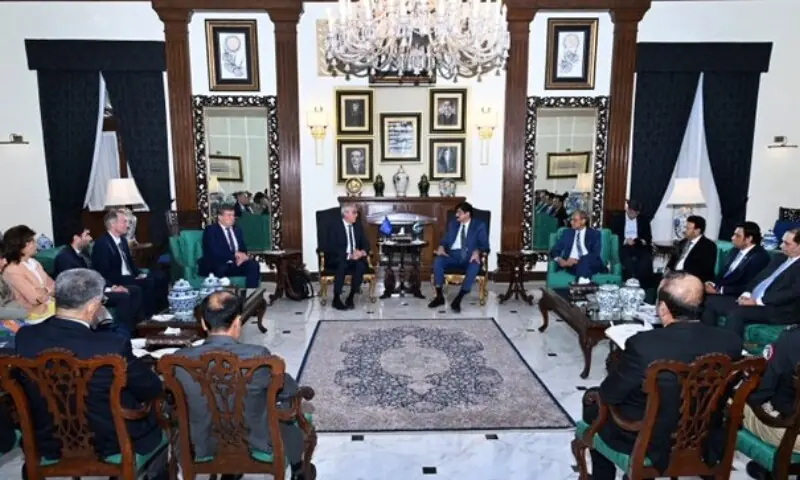
KARACHI Syed Murad Ali Shah, the chief minister of Sindh, welcomed the visiting European Union (EU) Monitoring Mission on Tuesday and reiterated his government’s commitment to social development, human rights, labour rights, governance, and environmental preservation.
As part of the Generalised Scheme of Preferences Plus (GSP+) scheme’s fifth Biennial Review, a seven-person EU delegation is in Karachi. Sirgio Baliberia, a directorate general for trade adviser to the GSP+ Directorate, was in charge of it.
Human rights, minority rights, including safeguards for transgender people, labour inspections, workplace safety, child rights, climate change, and the energy transition were all extensively discussed during the summit.
Jod Paul, the secretary of federal commerce, was also present at the gathering. Provincial ministers Saeed Ghani and Zia-ul-Hasan Lanjar, Chief Secretary Asif Hyder Shah, Inspector General of Police Ghulam Nabi Memon, Home Secretary Iqbal Memon, Secretary to the Chief Minister Abdul Raheem Shaikh, Law Secretary Ahmed Ali Baloch, Human Rights Secretary Khalid Chachar, and other high-ranking officials from Sindh were in attendance.
The EU has long been a partner in advancing rights-based government, according to the chief minister.
“Our collaboration with the European Union is crucial. For Pakistan’s exports, sustainable growth, and institutional changes, the GSP+ agreement is essential, he stated.
He mentioned that Sindh is fully collaborating with the Ministry of Commerce and federal institutions, adding that Pakistan is presently undertaking the fifth Biennial Review of GSP+. “A collaborative effort between the federal and provincial governments is reflected in the detailed responses submitted to the European Commission,” he continued.
The chief minister emphasised how the Sindh Treaty Implementation Cell (TIC) actively ensures adherence to all 27 international agreements related to the GSP+ program.
“A positive opportunity for direct engagement and assessment,” he said, praising the EU mission’s choice to visit the provincial TIC office during their trip to Karachi.
Sindh is the nation’s main export base, with important industries like manufacturing, fishing, textiles, and leather, according to Chief Minister Shah. He stated, “The continuation of GSP+ is essential for job creation, women’s economic empowerment, SME support, and poverty reduction.” He added that Pakistan would welcome technical assistance and capacity-building from the bloc and asked the EU to avoid “overly stringent conditions” in the upcoming GSP+ framework.
EU delegation informed on developments
The team was informed that between 2023 and 2025, the Sindh Human Rights Commission received 491 complaints, of which 50% were resolved and 62 suo motu cases were resolved. The provincial steering committee’s regular meetings guarantee supervision.
The Torture and Custodial Death Act of 2022 provided training to over 2,000 police officers. There are 1,356 active instances of violence against women in the courts, with 154 convictions, indicating “strengthened access” to justice.
403 houses of worship have been restored, and 33 minority protection police desks have been set up. 41 cases have been settled by a committed Journalists’ Protection Commission.
600,000 flood-affected properties have been registered in women’s names, according to the chief minister, marking “a historic step in empowerment.” Pink buses, vocational training, and a 15% quota in government employment for women are “major” steps, he continued.
A 0.5 percent job quota and local council seats are set aside for the transgender community.
The CM declared, “There is no compromise on labour rights.” In 2025, the Sindh Labour Department carried out 18,397 labour inspections, finding 1,936 infractions and imposing 1,446 fines.
He stated that around 3,500 drug addicts were rehabilitated under the Sindh Control of Narcotics Substances Act 2024.
Anti-corruption and good governance were also mentioned as important priorities. The chief minister stated, “154 officers are trained in modern investigation tools; an online anti-corruption system is active.”
According to the chief minister, the 2025 Child Labour Survey found that the rate of child labour has decreased from 20.6% to 10.3%.
He also mentioned that 4,190 kids are registered in 66 special education centres and 5,700 children with autism are enrolled at CRUs.
CM Shah expressed optimism that a successful fifth Biennial Review will be ensured by continued reforms, institutional cooperation, and positive engagement with the EU.