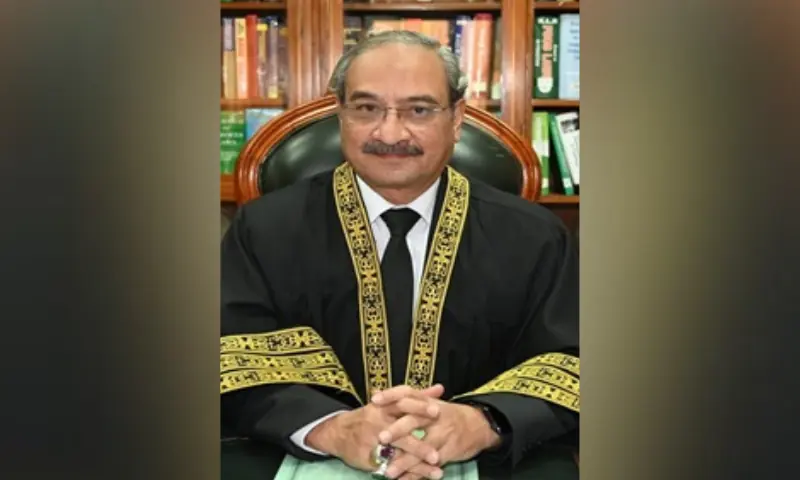
It was revealed on Wednesday that Justice Ali Baqar Najafi, who is currently a member of the Federal Constitutional Court (FCC), noted that the Noor Mukadam case is a direct outcome of a “vice” known as “living relationship” that is spreading throughout society.
The judge seemed to be alluding to a situation in which two unmarried people who are romantically involved live together.
In July 2021, Noor, 27, was discovered dead in Zahir Zakir Jaffer’s home in Islamabad. In May, a three-judge Supreme Court bench, led by Justice Hashim Kakar and including Justices Ishtiaq Ibrahim and Najafi, had upheld the death sentence awarded to Zahir, who was convicted by an Islamabad trial court in 2022.
Zakir’s review appeal against his death sentence was heard by the Supreme Court last month. The convict’s senior attorney, Khawaja Haris Ahmed, was informed by Justice Najafi during the hearing that it would be better for him to begin arguments after reviewing the extra note he had not yet submitted.
Later, Justice Najafi took the oath of office as a judge of the FCC, which was created earlier this month under the 27th Amendment to the Constitution.
Justice Najafi maintained Zahir’s sentence in a supplementary comment on the Noor murder case that was posted on the SC website today. He noted that “the present case is a direct result of a vice spreading in the upper society which we know as ‘living relationship’ [sic].”
He emphasised that under Sharia, these kinds of partnerships “defy not only the law of the land but also the personal law” and disregard “societal compulsions.”
The younger generation should be aware of the “horrible consequences, such as in the present case, which is also a topic for the social reformist to discuss in their circles,” according to Justice Najafi, who continued by labelling such a connection a “direct revolt against Almighty Allah.”
According to Justice Najafi, there were “no mitigating circumstances” in this particular case.
“Minor discrepancies in the time of occurrence, the delay in postmortem, the absence of the finger prints on the knife but matched with the petitioner’s DNA, and the minor delay in lodging the first information would not affect the credibility of the prosecution evidence, which had circumstantial evidence,” he stated.
“One end of the rope is found tied with the dead body of Noor Mukadam, and the other end is tied with the petitioner’s neck in this case of circumstantial evidence,” he stated.
Justice Najafi said that Noor’s father, retired diplomat Shaukat Mukadam, claimed to have “received the information […] about the murder of his daughter is well corroborated,” citing the filing of the first information report (FIR) at 11:30 p.m. regarding the incident that happened at 9:30 p.m.
“It is natural that after reaching the place of occurrence, the complainant, who is the victim’s real father, required some time and extraordinary nerves to absorb the extreme shock of his life and then draft the complaint for registration of FIR,” the judge concluded.
Justice Najafi stated, “This delay of conducting postmortem of about 12 hours is not fatal,” pointing out that the postmortem report indicated a gap of eight to nine hours between Noor’s death and her body’s autopsy.
The judge also brought up the CCTV tape that was acquired during the trial, which showed that watchman Mohammad Iftikhar locked the door after Noor sprang from the window and “came limping towards main gate to escape.”
He added that gardener Muhammad Jan “did not make any effort to stop” Zahir after he “snatched the mobile phone of [the] deceased, locked her in the outer cabin,” opened it, and physically attacked her.
“There are circumstantial evidence which connects the petitioner with crime, but it was not just seeing the petitioner (Zahir) with the deceased (Noor) prior to the unnatural death caused in the most brutal manner,” Justice Najafi said.
Regarding Zahir’s position, Justice Najafi stated that his account, which claimed Noor had overindulged in drugs, was “found incorrect” because neither the victim’s nor the convict’s medical records included any indication of intoxication, and the CCTV tape showed no “guest of drug party.”
Regarding Zahir’s insanity plea, the judge noted that there was “no evidence on record that the petitioner used to consult any psychiatrist, therapy workers, or consume any drug in the absence of which, or due to which, he became infurious and went out of mind.”
On July 20, 2021, Noor was discovered dead in a home in the posh Sector F-7/4 in Islamabad. Later that day, a first information report was filed against Zahir, who was taken into custody at the crime scene.
A district and sessions judge found Jaffer guilty of rape in February 2022 and sentenced him to death for the murder and 25 years of hard labour. Mohammad Iftikhar and Jan Mohammad, two members of his home staff who were co-accused in the case, received 10-year prison sentences.
An Islamabad district and sessions court indicted Zahir’s parents, prominent businessmen Zakir Jaffer and Asmat Adamji, in October 2021, however the court ultimately found them not guilty.
The lower court also indicted six Therapy Works administrators, whose workers had visited the murder scene prior to police, but they and the parents were ultimately exonerated of the allegations.
The parents and the therapists attempted to hide the crime and destroy the evidence, according to the challan.
In March 2023, Zahir’s appeal against the conviction was dismissed by the Islamabad High Court (IHC), which not only affirmed the death punishment but also changed his 25-year prison sentence to another death sentence. Additionally, the main suspect’s employees’ appeals against their conviction were denied by the IHC.